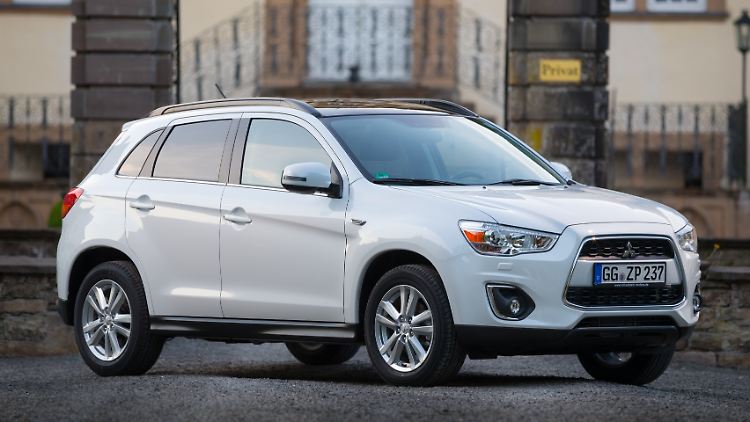
Old vehicles in the used car market are not always convincing. There can be problems with quality and durability. The Mitsubishi ASX, however, shows that it can be different: it performs well in the TÜV main inspections.
The first-generation Mitsubishi ASX was available between 2010 and the end of 2022. Three facelifts kept the compact SUV fresh over the long period before it was retired by the second generation in spring 2023. The TÜV knows how this long-runner performs as a used vehicle.
Quality
The ASX gives TÜV inspectors little trouble during main inspections (HU). Across all age groups, this Japanese vehicle performs better in main inspections than the average of the vehicles inspected. Even in the 12- to 13-year-old age group, two-thirds of the test subjects pass the check without any defects, compared to an average of 56.4 percent.
However, TÜV inspectors are not entirely idle. From the third inspection onwards, the focus shifts to steering joints, as well as the function of the foot and parking brake. Some vehicles are occasionally noted for oil leaks.
Body and Interior
Measuring 4.30 meters in length, with pronounced wheel arches and short overhangs, the Mitsubishi ASX brought the typical characteristics of a compact SUV at its debut and stuck with them. Although the three facelifts (2012, 2016, and 2019) brought an increase in length, with the Japanese model growing to 4.37 meters towards the end of its production, it still falls within the compact segment.
The brand’s current design language is most evident in the front design. From the initially brand-typical jet fighter design to a more understated face in 2012, and back to a more distinctively styled grille in 2019, the ASX showcases various design facets.
Inside, the focus was on functionality, with a more robust rather than luxurious feel. The interior space is decent, as is the build quality. The trunk volume varies depending on the position of the rear seatbacks, ranging from 420 to 1220 liters.
Engines and Drivetrain
Mitsubishi offered four-cylinder gasoline and diesel engines. All-wheel drive was available optionally or from the factory. At launch, there was a 1.6-liter gasoline engine with 86 kW/117 hp and a 1.8-liter diesel with 110 kW/150 hp. The gasoline engine was only available with front-wheel drive, while buyers of the diesel could also opt for 4×4 drive. With the first facelift, another diesel was added to the engine lineup: a 2.2-liter with 150 hp, which came standard with all-wheel drive, with a six-speed automatic available as an option. Except for the base gasoline model, the other versions used manual six-speed transmissions.
In late 2018, Mitsubishi removed diesel engines from the lineup; since late 2019, a two-liter gasoline engine with 150 hp was the only option. Power was transmitted through a manual five-speed gearbox, with all-wheel drive available at an extra cost.
Equipment and Safety
At its market launch, the ASX was relatively sparsely equipped. For example, air conditioning was initially only included from the second trim level onwards. Stylish details like alloy wheels were also reserved for higher comfort levels. The definitions and number of equipment levels have changed over the years, so it is important to pay attention to which comfort features are included. In terms of safety, the compact SUV has improved over the years. While there were no assistants available at the beginning of its career, they were available towards the end.
Conclusion
The Mitsubishi ASX demonstrates that older used vehicles can perform well in TÜV main inspections. However, potential buyers should keep an eye on weak points such as steering to avoid unpleasant and costly surprises. Those who are not expecting the trendiest design can give this Japanese model a chance. Currently, around 500 used first-generation Mitsubishi ASX vehicles are offered on mobile.de, starting at around 4500 euros.